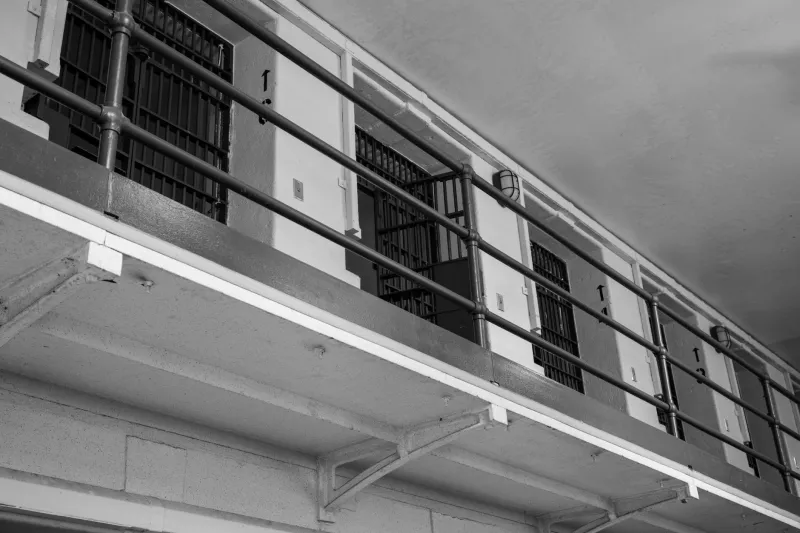
Bound by the Numbers: How Mandatory Minimum Sentences Became America's Instrument of Racial Control

When Congress stripped federal judges of the power to exercise mercy, it did not create a more uniform justice system — it created a more brutal one. Mandatory minimum sentencing laws have functioned, in practice, as a mechanism for incarcerating Black Americans at rates that can only be described as a structural crisis. The courtroom, once a space where individual circumstances could at least theoretically matter, has been transformed into a processing facility where human beings are reduced to statutory categories and years are assigned like inventory codes.
This is not an accident. It is a design.
The Architecture of Inflexibility
Mandatory minimum sentencing laws require judges to impose fixed prison terms for specific offenses, regardless of the defendant's history, role in the offense, mental health status, or any other mitigating factor a reasonable person might consider relevant. The laws emerged in earnest during the 1980s, wrapped in the political rhetoric of the War on Drugs — a campaign that, as subsequent research has confirmed, was never primarily about public health or safety.
The 1986 Anti-Drug Abuse Act is among the most consequential and most damaging pieces of legislation in American criminal justice history. It established the now-infamous 100-to-1 sentencing disparity between crack cocaine and powder cocaine offenses — meaning that a person caught with five grams of crack faced the same mandatory five-year federal sentence as someone caught with 500 grams of powder cocaine. Crack cocaine was predominantly associated with Black urban communities. Powder cocaine was predominantly associated with white and affluent users. The disparity was not incidental. It was baked into the statute.
The Fair Sentencing Act of 2010 reduced that ratio to 18-to-1. The First Step Act of 2018 made that reduction retroactive. These were meaningful reforms, celebrated rightly by advocates. But they did not dismantle the architecture. They repainted a portion of one wall.
Judges Speak — and the Law Does Not Listen
Perhaps the most striking testimony against mandatory minimums comes not from defense attorneys or civil rights organizations, but from the federal judiciary itself. Judges — individuals appointed to interpret and apply the law with wisdom and discernment — have repeatedly and publicly expressed anguish at being compelled to impose sentences they found profoundly unjust.
In 2013, U.S. District Judge John Gleeson, a former federal prosecutor, sentenced Chevelle Nesbeth to time served and probation after she was convicted of a drug importation offense — and then wrote a lengthy opinion cataloguing the collateral consequences of a felony drug conviction that he argued made incarceration doubly punitive. His sentencing decision was ultimately reversed on appeal, and Nesbeth was sent to prison. The judge's moral reasoning did not survive contact with the mandatory structure.
Judge Gleeson was not alone. Dozens of federal judges have issued statements, opinions, and public remarks over the past three decades lamenting their inability to account for the full humanity of defendants standing before them. Judge Mark Bennett of the Northern District of Iowa once described sentencing low-level drug couriers to decade-long terms as one of the most professionally painful experiences of his career. He compared the process to assembly-line justice — a phrase that should disturb every citizen who believes in the principle of individualized adjudication.
When the people tasked with administering a law describe it as unjust, the law is unjust.
The Numbers Do Not Lie
The racial data surrounding mandatory minimums is not ambiguous. According to the United States Sentencing Commission, Black male defendants receive sentences approximately 19.1 percent longer than similarly situated white male defendants for the same federal offenses. A substantial portion of that disparity is attributable to mandatory minimum statutes and the prosecutorial charging decisions that trigger them.
Prosecutors hold enormous power in this system. They decide which charges to file, and the charges they file determine which mandatory minimums apply. Studies have consistently shown that Black defendants are more likely to be charged in ways that trigger mandatory minimums than white defendants accused of comparable conduct. The discretion that has been removed from judges has not been eliminated from the system — it has been relocated to prosecutors' offices, where it operates with far less transparency and far less accountability.
This dynamic echoes what we documented in the Jena 6 case: the charging decision is where racial bias most effectively conceals itself behind the language of neutral legal procedure. When a district attorney reaches for the most severe available charge, that decision carries the full weight of mandatory sentencing law. The defendant, often unable to afford adequate legal counsel, faces a binary choice — accept a plea to a lesser offense or go to trial and risk decades under a mandatory minimum. This is not a justice system. It is a coercion system.
Grassroots Resistance and Legislative Openings
The movement to reform mandatory minimums has built real, if incomplete, momentum. Organizations including the American Civil Liberties Union, Families Against Mandatory Minimums, and the NAACP Legal Defense Fund have sustained years of advocacy that have produced tangible legislative results at both the federal and state levels.
Michigan repealed many of its mandatory minimum drug laws in 2002, and subsequent analysis showed no increase in drug-related crime — directly refuting one of the central arguments made by proponents of these laws. New York reformed its Rockefeller Drug Laws, which had been among the harshest in the nation, through a series of legislative changes between 2004 and 2009. Several states have expanded the use of judicial safety valves — provisions that allow judges to depart from mandatory minimums in cases involving low-level offenders with no violent history.
These reforms matter. They represent lives that will not be destroyed, families that will not be dismembered, communities that will retain their members. But the federal system remains largely intact, and in many states, mandatory minimums continue to govern tens of thousands of cases annually.
The current political moment contains both peril and possibility. There are members of Congress on both sides of the aisle who have expressed interest in further sentencing reform. The coalition that produced the First Step Act demonstrated that criminal justice reform is not inherently a partisan issue. But interest is not legislation, and legislation without enforcement is not justice.
What Justice Actually Requires
Justice — real justice, not the procedural simulacrum that mandatory minimums produce — requires the capacity to see a human being as a human being. It requires that the circumstances of a person's life, the nature of their conduct, and the proportionality of their punishment all be weighed by someone with the authority and the obligation to weigh them.
Mandatory minimums eliminate that capacity by design. They replace judgment with arithmetic. They tell a judge: the number has already been decided. Your job is only to announce it.
For the communities most targeted by these laws — Black Americans, low-income defendants, people ensnared in drug economies shaped by decades of disinvestment and neglect — this is not a technical legal problem. It is a lived catastrophe. Fathers removed from households for a decade over an offense that a similarly situated white defendant resolved with probation. Mothers separated from children during the years those children most need them. Young people entering the federal prison system and emerging, years later, into a world that has moved on without them.
The Jena 6 case forced a nation to confront how prosecutorial overreach and racially skewed charging decisions could transform a schoolyard fight into a potential life sentence. Mandatory minimums operate by the same logic, at industrial scale. They take the worst impulses of a racially stratified criminal justice system and encode them into statute, making them harder to see and harder to challenge.
Reforming these laws is not a favor to criminals. It is an obligation to justice. And justice, as this platform has always maintained, cannot be delayed any further.